
Connectional Council Announces Election of General Conference Administrative Committees
March 26, 2026

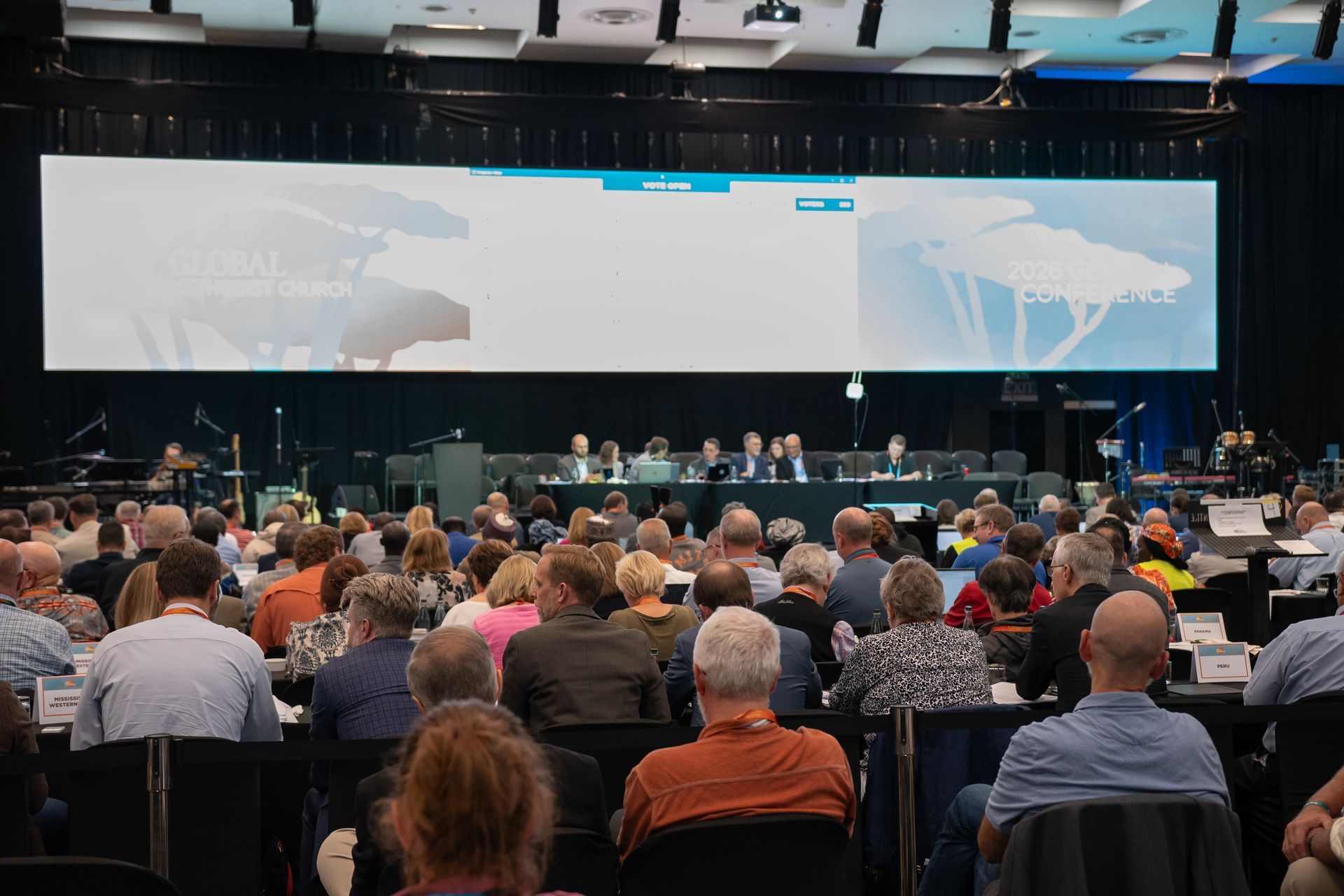
There are five administrative committees that shepherd the work of the General Conference, where delegates have a say in how the conference functions. These are: Agenda (in what order will the business of the conference be dealt with), Credentials (who is credentialed as a delegate), Journal (approves the accuracy of the minutes of the conference and advises the secretary on compiling the new Book of Doctrines and Discipline), Nominations (who is recommended to be elected to the general church commissions, councils, and committees), and Reference (what petitions are valid and what legislative committee should deal with each petition).


These committees are made up of General Conference delegates nominated by their delegation, recommended by the General Conference Commission, and elected by the Connectional Council.


The members elected by the Connectional Council are based on the following principles:

·       People who are well qualified to do the work

·       Representation from as many annual conferences as possible from the global church

·       Each committee being half clergy and half lay

·       Striving for gender balance


The Book of Doctrines and Discipline requires that members of the administrative committees shall have also been delegates to the preceding General Conference in Costa Rica. This requirement prevented most of the European, Filipino, or Latin American annual conferences from nominating anyone for these committees because their current delegates were not delegates in 2024. Therefore, the committees are roughly half-African and half-U.S. in voting membership. (Legislation has been submitted to eliminate this requirement for future General Conferences.)


Due to this requirement, conferences that were not part of the Global Methodist Church in 2024 would also be excluded. The Connectional Council voted to add two non-voting members to each committee except the Agenda Committee to provide representation from those conferences joining since 2024.


The Connectional Council also voted to add a non-voting advisory team to assist the Nominations Committee in their work. The advisory team will consist of two GMC staff persons, two bishops, and two conference superintendents. The goal is to have more people in the room who know the nominees and can give guidance in forming the slate of recommended general church commission members.


We received nominations from 18 of the 30 annual conferences present in Costa Rica. Some of the 12 who did not submit nominations were precluded by the above requirement. Others chose not to submit nominations. Of the 18 conferences that submitted nominations, 17 have members elected to a committee.


We also received nominations from 9 of the 17 annual conferences not in Costa Rica. Eight of them have a non-voting member on one of the committees.


In addition, 40 percent of the voting members are women.


The Reference and Nominations Committees will begin working immediately, as most of their responsibilities are carried out well before the General Conference meets. The Agenda, Credentials, and Journal Committees will begin meeting in May, with the Journal Committee’s responsibilities continuing for several months after the General Conference adjourns in September.


Please keep these committee members in prayer as they seek to facilitate the work of the General Conference.


ADMINISTRATIVE COMMITTEE MEMBERS

2026 GENERAL CONFERENCE

Elected: March 23, 2026


Agenda Committee

Lay Members:

Mary Balgojevich – Western States

Norma Morrison – Upper Midwest

Walter Oduke – Kenya

James Pollitt – Allegheny West

Clergy Members:

Jill Jackson-Sears – Mid-Texas

John Beyers – North Georgia

Kora Mujinga – Democratic Republic of Congo

Bulelani Nontshakaza – South Africa


Credentials Committee

Lay Members:

Therese Bidiaku Pangi – Democratic Republic of Congo

Elizabeth Chancey – Mid-South

Martha Thompson – South Carolina

Luvo Thwethwa – South Africa

Lily Maijamaa – Northern Nigeria (non-voting)

Clergy Members:

Jason Burnham – Trinity

Joy Griffin – North Georgia

Upendo Likondi – Tanzania

Wilton Odongo – Kenya

David Almanza – Mexico (non-voting)


Journal Committee

Christopher Gadlage – Great Lakes (clergy)

Fidelis Samwel – Kenya (lay)

Chappell Temple – Trinity (clergy)

John Kalambo – Zambia (clergy, non-voting)

Ganizani Nkhambule – Malawi (lay, non-voting)


Nominations Committee

Lay Members:

Holly Joy – Mid-South

Tamyra Nies – Allegheny West

Dennis Rader – Northeast

Debbie Smalley – Alabama Emerald Coast

Sheela Shankar – India (non-voting)

Clergy Members:

Mbingeleli Diko – South Africa

Jessica LaGrone – Trinity

Jonathan Lee – Upper Midwest

Henriette Okele – Democratic Republic of Congo

Samson Muzengeza – Zimbabwe (non-voting)


Reference Committee

Lay Members:

Bill Brown – Heartland

James Allred – North Georgia

Jana Fox – Mid-Texas

Christian Mwite Mwango – Democratic Republic of Congo

Stephen Gambo – Central Nigeria (non-voting)

Clergy Members:

John Howard – North Carolina

Rosette Ngoy Kalumba – Democratic Republic of Congo

Greg Stover – Allegheny West

Bonface Wanyama – Kenya 

Hen Su Andrei Kim – Northwest Russia-Bel


Related Posts
March 26, 2026
As of March 15, 2026, 28 individuals have been received as episcopal nominees by the Global Episcopacy Committee (GEC) of the Global Methodist Church. This list reflects nominees submitted by Annual Conference delegations by the preferred deadline. Additional nominees may continue to be submitted by Annual Conferences through May 15, 2026. In the spirit of transparency and to support the work of delegations, the Global Methodist Church is releasing this preliminary list to allow delegations to begin their work of prayerful discernment in advance of the Area Committees on Episcopacy (AEC) assignment plenary session scheduled for May 31, 2026. As previously announced, eight full-time bishops will be elected and consecrated at General Conference 2026, taking place August 30 through September 6, 2026, in Johannesburg, South Africa. Those elected will serve six-year terms beginning November 5, 2026. Global Methodist bishops are traveling, apostolic leaders set apart for a ministry of visionary servant leadership, general oversight, and supervision in support of the church’s mission. They lead the temporal and spiritual life of the church, defend the faith, and deploy the clergy. According to the Book of Doctrines and Discipline , “Nominees for the episcopacy should have a strong record of effectiveness in leading the church in evangelism, discipleship, and mission.” We offer this information with gratitude for those who have said yes to being considered and with prayerful anticipation for how the Lord will guide the Church through this discernment. Preliminary List of Episcopal Nominees Six of the current active bishops have offered themselves for re-election: Bishop Leah Gregory Bishop Eduard Khegay Bishop Kimba K. Evariste Bishop Carolyn Moore Bishop John Pena Auta Bishop Mark Webb In addition to those continuing in consideration, the following nominees have been put forward by Annual Conference delegations from across the connection to date:
January 13, 2026
To view in your preferred language, select your language from the dropdown menu at the bottom of the page.
December 11, 2025
Read in French | Read in Korean | Read in Portuguese | Read in Spanish | Read in Swahili December 08, 2025 Dear General Conference Delegations, As chair of the Global Episcopacy Committee (GEC), I am pleased to formally call the 2026 plenary gathering of those selected by their delegations to serve on our future Area Committees on Episcopacy. The purpose of this gathering will be to approve the composition of our 2026–2032 episcopal areas, as directed by BDD ¶604.3. The plenary gathering will be held online on Saturday, May 30, 2026, at 8:00 a.m. Central Daylight Time (UTC-5). The lay member and clergy member you select will meet with their counterparts from other GMC conferences around the world to consider a report from the GEC on the groupings of annual conferences that will share a bishop. Your GEC and the Assembly of Bishops will participate in the plenary gathering with voice but without vote. The exact number of episcopal areas will be announced in early 2026. The GEC’s proposal for the episcopal areas will be based on the data submitted by each delegation. It is our intention to publish our recommendations and rationale prior to the plenary gathering. Approval will require a simple majority vote. Once the map of episcopal areas is approved on May 30, each area committee will enter a virtual breakout room. Members of the GEC will facilitate the election of officers. Each area committee will then begin its work: identifying leadership needs and deciding which episcopal nominees to interview. A full profile of each nominee—including current bishops who are making themselves available for re-election—will be provided. Area Committees will also have access to confidential files made available by the GEC. Each area committee is asked to produce a ranked list of its top five choices by July 22, 2026 . These lists will be shared with the delegates of the General Conference. Nominees who appear on a ranked list may be invited to participate in video interviews. Once gathered in Johannesburg, delegates will elect a bishop to each specific episcopal area. Because this process will repeat every six years, there will be future opportunities to reconsider both the shape of episcopal areas and those who serve them. As you can see, the task entrusted to the Area Committees on Episcopacy is significant. A draft document further defining the responsibilities of these committees is available on the election page of The Beauty of Holiness website . Please keep in mind the following guidelines: A person nominated to be bishop is not eligible to serve on an area committee on episcopacy. While the persons you select must be members of your annual conference, they do not have to be members of your delegation. Please select persons who have reliable internet access and experience with online meetings. This is essential for both the plenary gathering and the candidate interviews. Translation services are being secured for the plenary gathering. However, the ability to communicate across languages will be helpful throughout the process. Those who do not speak the language used by their area committee may need to secure a personal translator or translation service. Those elected to your area committee should be prepared to participate in hours of interviews in June and July of 2026. The time commitment will be significant. Delegations are reminded to submit the following items by March 15, 2026: The names of one lay person and one clergy person selected to serve on your future area committee on episcopacy (please include their e-mail address, clergy/laity status, and languages they speak); A ranked list of ten annual conferences with whom your delegation believes it should be grouped in a shared episcopal area (rationale statements are welcome); Up to one episcopal nominee from your annual conference and up to one episcopal nominee from outside your conference. Thank you for your faithful work in building the Global Methodist Church and spreading scriptural holiness across the globe. Please join me in praying that the Holy Spirit will guide and bless the selection process for our first elected slate of full-time bishops. Grace & Peace, Rev. Dr. Chris Ritter Chairperson Global Episcopacy Committee globalepiscopacycomm@globalmethodist.org
November 20, 2025
General Conference Registration & Travel Update: Everything You Need to Know
By Global Methodist Church March 27, 2025
In order to guide annual conferences in electing delegates to the 2026 General Conference, the General Conference Commission has released its projections of how many delegates each annual conference will have. The official number of delegates for each annual conference will be set in February 2026, based on the number of churches and pastors on January 1, 2026. Most delegates will be elected at annual conference meetings beginning in April, so it was necessary to provide preliminary guidance for how many delegates each conference should elect. Conferences will want to ensure they elect enough alternate and reserve delegates in case their official number increases a year from now. This preliminary allocation sets the number of delegates at 420, which is at the high end of the acceptable range established by the Connectional Council. The allocation is based on estimated church and pastor numbers submitted by each conference superintendent. The big story told by these numbers is the shift in the number of delegates between the U.S. and other parts of the global church, particularly Africa. In 2024, African delegates made up twelve percent of the delegates to Costa Rica. In 2026, African delegates may make up one-third of the delegation. This means the U.S. share may go down from 84 percent in 2024 to 61 percent in 2026, resulting in the loss of some delegates by some U.S. annual conferences. This shift is larger than originally anticipated, as eight more African annual conferences are in development than expected when the number of delegates was set at 380-420. In addition, the number of churches and pastors in the four Nigerian conferences is greater than expected, and the Democratic Republic of Congo (now split into six annual conferences) has also experienced unexpected growth. While Africa had only five annual conferences in 2024 at Costa Rica, they could have as many as 27 annual conferences represented in 2026. However, it is questionable whether all these annual conferences will be able to organize and have their convening conferences by the end of this year. The number of African annual conferences will probably be less than the 27, which will reduce the total number of delegates. Individual congregations throughout Africa will also need to go through the official registration process, which may further reduce their numbers. The same is true of Asia and Latin America, both of which are projected to add two annual conferences each. The General Conference Commission will recommend the final allocation of delegates to the Connectional Council based on actual official numbers, rather than estimates. That final allocation in February could see some delegate numbers shifting slightly up or down. The preliminary allocation of delegates is posted on the Global Methodist Church website here. As annual conferences elect delegates, alternates, and reserves for the 2026 General Conference, we can surround the process with prayer, relying on the Holy Spirit to guide the election of gifted leaders to help our denomination move forward in mission. We can also rejoice at the rapid growth of the Global Methodist Church in Africa, Asia, and Latin America. If all of the projected annual conferences come on line, the Global Methodist Church will be found in more than 27 different countries. We are becoming more global by the day! Reverend Thomas L. Lambrecht serves as the General Conference Secretary for the Global Methodist Church.
By Global Methodist Church February 27, 2025
Commission on General Conference Releases Key Details, with More to Come in Future Weeks